
Hair Transplant Repair
Surgery in the UK
A poor hair transplant can leave lasting concerns. Specialist repair surgery can improve unnatural hairlines, scarring, density and misplaced grafts.
Dr. Asim Shahmalak will assess both the transplanted area and your remaining donor supply before explaining what can realistically be improved.
- Outstanding rated by the CQC
- GMC-registered Surgeon
- FUE, FUT and Corrective Hair Restoration Experts
- 20+ Years' Experience
Hair Transplant Repair At A Glance
Repair surgery is often more complex than a first hair transplant. Not every previous result can be completely reversed, and donor hair availability may limit what can safely be achieved.
Starting from £5,000
-
Assessment
Previous transplant, donor area, scarring and future hair loss reviewed
-
Anaesthetic
Local anaesthetic where corrective surgery is required
-
Possible corrections
Hairline redesign, additional grafting, graft removal or repositioning, scar camouflage
-
Going home
Same day after surgery
Your Hair Transplant Repair Journey
From assessing previous work to correcting the main concerns, each stage is planned around improving appearance while preserving the remaining donor supply.
-
Detailed assessment
Your surgeon examines the donor and recipient areas, existing grafts, scarring and remaining donor hair to determine what can realistically be improved and whether further procedures may be required.
-
Repair planning
A repair plan is created around the main concerns, such as hairline shape, graft direction, density, scarring and donor preservation. Some cases may require more than one procedure.
-
Donor management
If new grafts are needed, the remaining donor supply is assessed carefully. Previous surgery may limit available hair, so extraction must be planned conservatively.
-
Graft removal where required
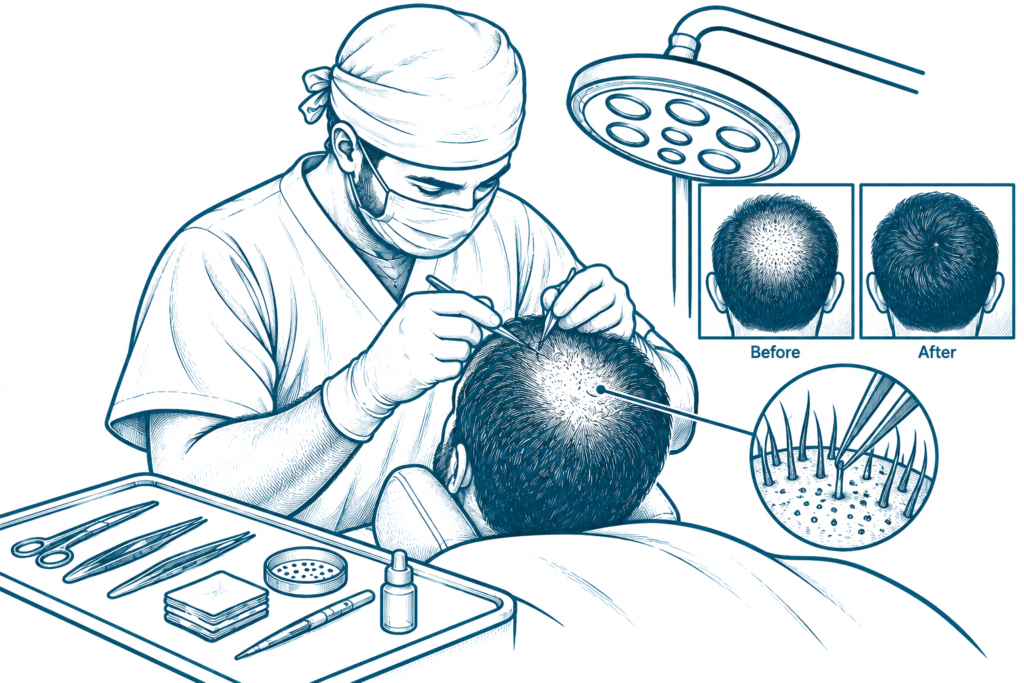
Poorly positioned or unnatural-looking grafts may be selectively removed. Existing follicles that can be incorporated into the revised design may be retained.
-
Additional graft placement
New grafts may be used to soften the hairline, improve density, cover scars, replace removed follicles and improve overall direction and coverage.
-
Aftercare
Corrective surgery is performed under local anaesthetic, and patients return home the same day. Allow 7-10 days for early recovery and follow the aftercare instructions provided.
Surgeon-led Hair Transplant Repair Treatment
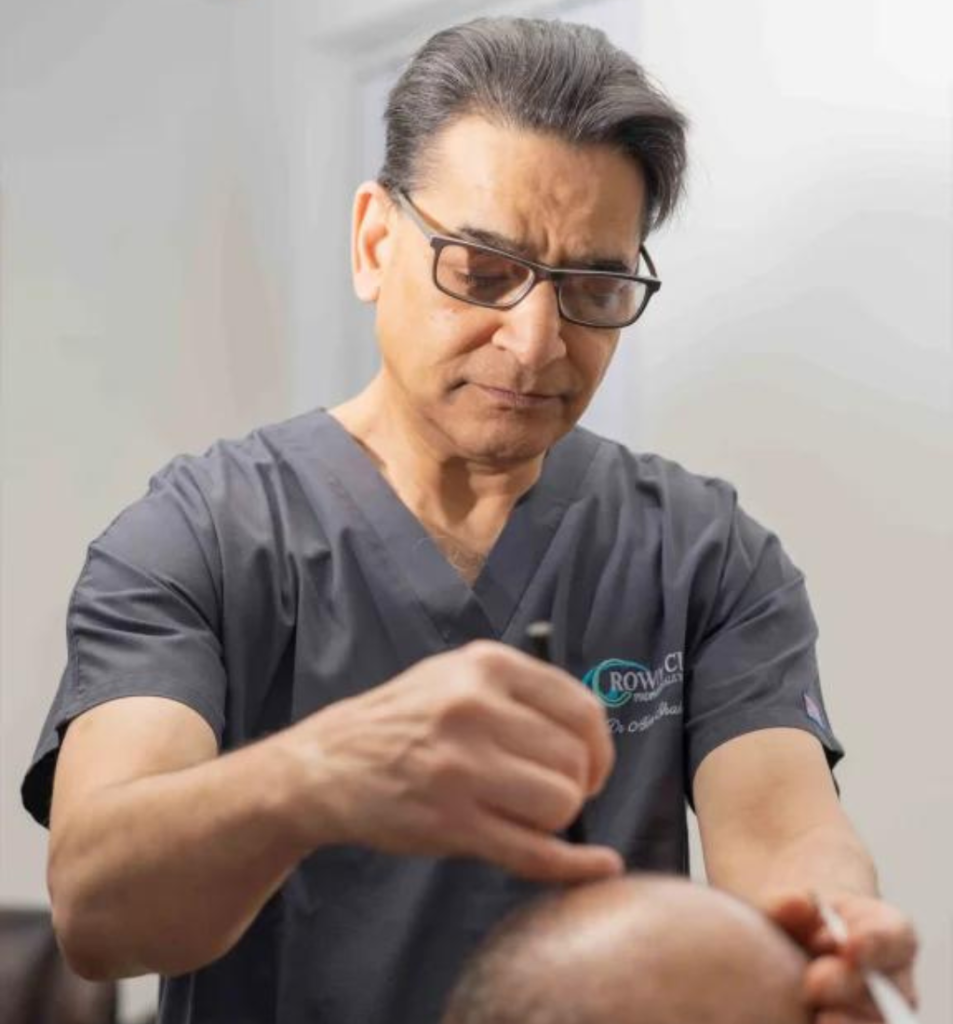
Dr. Asim Shahmalak has more than 20 years of hair transplant experience following a previous career in general surgery within the NHS.
Repair work requires a different approach from first-time surgery because the surgeon is working with tissue, follicles and donor areas that have already been altered by previous treatment.
Recovery after hair transplant repair
Recovery varies depending on the type and extent of corrective work performed.
-
First 48 hours
First 48 hours
The donor and recipient areas may feel tender, with some redness, swelling and small crusts. Follow your post-operative care instructions carefully during this early stage.
-
Days 7-10
Early settling
The treated areas begin to settle and small crusts gradually clear as healing continues. Crown Clinic currently recommends allowing 7 days for early recovery.
-
Weeks 2-8
Healing and shedding
Some of the newly transplanted hairs may shed during this period. This can be a normal part of the hair transplant growth cycle.
-
Months 3-4
Early growth
Early new growth may begin to appear as successfully transplanted follicles start producing hair.
-
Months 6-9
Visible development
The corrective result becomes more noticeable as additional growth develops and the treated areas continue to improve.
-
Months 9-12+
Long-term assessment
The overall improvement becomes easier to assess as growth matures. Complex treatments may require more than one visit. Your surgeon will advise when the final result can reasonably be evaluated.
How much does hair transplant repair cost?
Your treatment cost reflects what needs to be corrected, the donor hair available and the surgical approach required to improve your result.
Book a Consultation
Trusted by Our Patients
Hear from patients who came to Crown Clinic after previous transplant procedures and chose a more personalised approach to corrective treatment.
From the ‘point of contact’ with Mr Asim Shahmalak and his colleagues, all options were laid out regarding my hair loss.I decided to opt for 2500 grafts via FUE and a course of PRP.Mr Shahmalak and his team put me at ease, before and during the surgery, and explained each process of the procedure.
From start to finish 10 days later the whole treatment was a positive experience. I have some needs and don’t always feel comfortable with people I don’t know, but at the clinic I felt like I did know everyone they were excellent at putting me at ease.
Thank you to Mr Shahmalak, Afshan and the team at Crown Hair Clinic. Thank you to Mr Shahmalak, Afshan and the team at Crown Hair Clinic. Both Mr Shahmalak and Afshan put me at ease straight away.
All the available options were explained regarding my hair loss. I decided to undergo 2,500 FUE grafts together with a course of PRP. The treatment and aftercare were carried out to a very high standard.
I’m really glad I chose Crown Clinic for my FUE hair transplant. Everyone was incredibly helpful, friendly and professional, and the entire experience was first class.
I opted for a FUT procedure and felt no pain. I was given clear aftercare instructions and was already seeing hair growth in the transplanted area after seven days.
Throughout the six-hour operation, I was kept fully informed. After the strip removal, the skilled technicians prepared and inserted the hairs into the recipient area. The entire service was first class.
One year on, I have eyebrows. I am so pleased with the result — I look like a different person altogether.
Crown Clinic brought an ordeal caused by previously poor surgery to an end — not only fixing the matter but making it a positive experience.
As the recipient of a 1980s plug-based hair transplant, I was nervous about another procedure. Dr. Shahmalak and his team completed such neat and precise work that my recovery was extremely quick.
My hair became very fine and thin following the birth of my daughter. The treatment I received from start to finish was first class, and I am so relieved that I chose Crown Clinic.
I booked an FUE procedure, and the day ran exactly as Dr. Shahmalak had explained. It is still early, but I am already very pleased with the results.
The whole experience was exceptional. Mr Shahmalak and his team were extremely professional and operated like a well-oiled machine. From my experience, you get what you pay for.
The conduct of the staff was outstanding and the care I received was exemplary. I would certainly recommend Crown Clinic to anyone considering an FUE procedure.
Really happy with my initial consultation. Dr. Shahmalak made me feel very welcome and comforting that he clearly is an expert in his field. A prompt surgery date was made as I wanted the procedure asap as I get married this year. Very pleased with the facilities and care on the day of surgery. All the grafts were removed by the Doc himself, his team were very friendly and made me feel comfortable.
On the day of surgery, everyone was so welcoming, informative, and professional. I have since received great aftercare and am really excited about seeing the full results.
I found my experience with Crown Clinic to be exceptionally caring and professional. I would unreservedly recommend them to other prospective patients.
Right from the first consultation everything was explained clearly. I was told what the. procedure would be and what area would be covered on my head and possibly more depending on the donor hair available. When I arrived, they were very professional and very reassuring.

From the first consultative phone call with Afshan to the procedure itself with Dr. Shahmalak and the postop care of his team, I found my experience with Crown Clinic to be exceptionally caring and professional. I would unreservedly recommend them to other prospective patients.
My experience with Dr. Shamalak and his entire team was nothing short of outstanding. Throughout the entire process their professionalism and patient care was front and fore always.
Initial delay with my initial contact response, but since then, everything has been ‘A1’. Made me feel very comfortable, knowledgeable about the procedure, kept informed at all times. Day of procedure went far better than expected, even got a cream cake!
The healing took a maximum of ten days. I followed all the aftercare instructions and was amazed by how quickly the healing progressed.
I had researched the FUT procedure and its outcomes, which Dr. Asim confirmed was the right approach for me. I felt comfortable, reassured and truly cared for throughout.
The skill and attention to detail were excellent. The FUT strip procedure went much more smoothly than I expected, and I feel confident it will transform my hair and restore my confidence.
As a woman experiencing hair loss, I was advised on the most appropriate procedure without having my head shaved. The care and attention I received throughout were outstanding.
Five months after the procedure, my eyebrows are growing all the time. My right eyebrow has practically grown through, and my left is slowly catching up. Thank you for changing the way I feel about myself.
Having previously undergone a hair transplant in Turkey, I began to witness superior results after my FUE procedure at Crown Clinic. The difference in communication, care and results was striking.
Having previously had a FUT procedure at another clinic, my FUE at Crown Clinic demonstrated just how professional the team are. I could already see how neat and precise the procedure had been.
As a woman experiencing hair loss and not wanting my head shaved, I was advised on the most appropriate procedure for me. The service was caring, private and completely patient-centred.
I had been researching FUE for a while, but after my consultation with Dr. Shahmalak, my mind was made up instantly. The process was seamless, and the post-surgery support was excellent.
Since my FUE hair transplant at Crown Clinic, I have begun to witness superior results compared with my previous transplant. The support, guidance and professionalism have left me utterly impressed.
I opted for 2,500 grafts via FUE and a course of PRP. The surgery, pre-care and aftercare were all carried out to a very high standard. I would highly recommend Crown Clinic.
Initial delay with my initial contact response, but since then, everything has been ‘A1’. Made me feel very comfortable, knowledgeable about the procedure, kept informed at all times.
Every stage of the procedure, including before and aftercare, was explained and documented in an easy to understand way. On the day of surgery the staff made me feel relaxed throughout and I was very impressed with The Crown Clinic facilities. Dr. Shamalak is outstanding at what he does and is a true gentleman. I felt very safe in his experienced hands throughout. I now look forward to seeing the results of their hard work over the coming months.
This was quite a nerve-wracking experience for me, but everyone in the Crown team put me at ease and made the experience as comfortable as it possibly could be. From my initial consultation, to the surgery itself, the procedure was explained openly and clearly, and ample opportunities given for questions.
Take The Next Step
Every repair case is different. Begin with a specialist assessment focused on realistic improvement, donor preservation and long-term planning.
Frequently asked questions
In most cases, something can be improved, though how much depends on what was done before, how much scarring there is and how much donor hair remains. Correction takes more than one session, depending on the case's complexity. A complete reversal is not always possible, and your surgeon will be clear about that at assessment.
Usually an unnatural or too-low hairline, grafts placed at the wrong angle or in visible clumps, thin or patchy density, and visible scarring from the donor area. Overharvested donor areas are also common.
Yes. A hairline can be softened by removing the grafts that look unnatural and adding single hair grafts in front, which will create a natural looking hairline. It often takes more than one procedure.
Yes. Poorly positioned grafts can be removed individually and either replanted elsewhere or donated to the University of Manchester for research, with the patient's permission.
Often they can. Where the follicles are healthy, removing and repositioning them makes better use of a donor supply that previous surgery may already have depleted.
